A Tragic Avalanche and the Perils of Groupthink
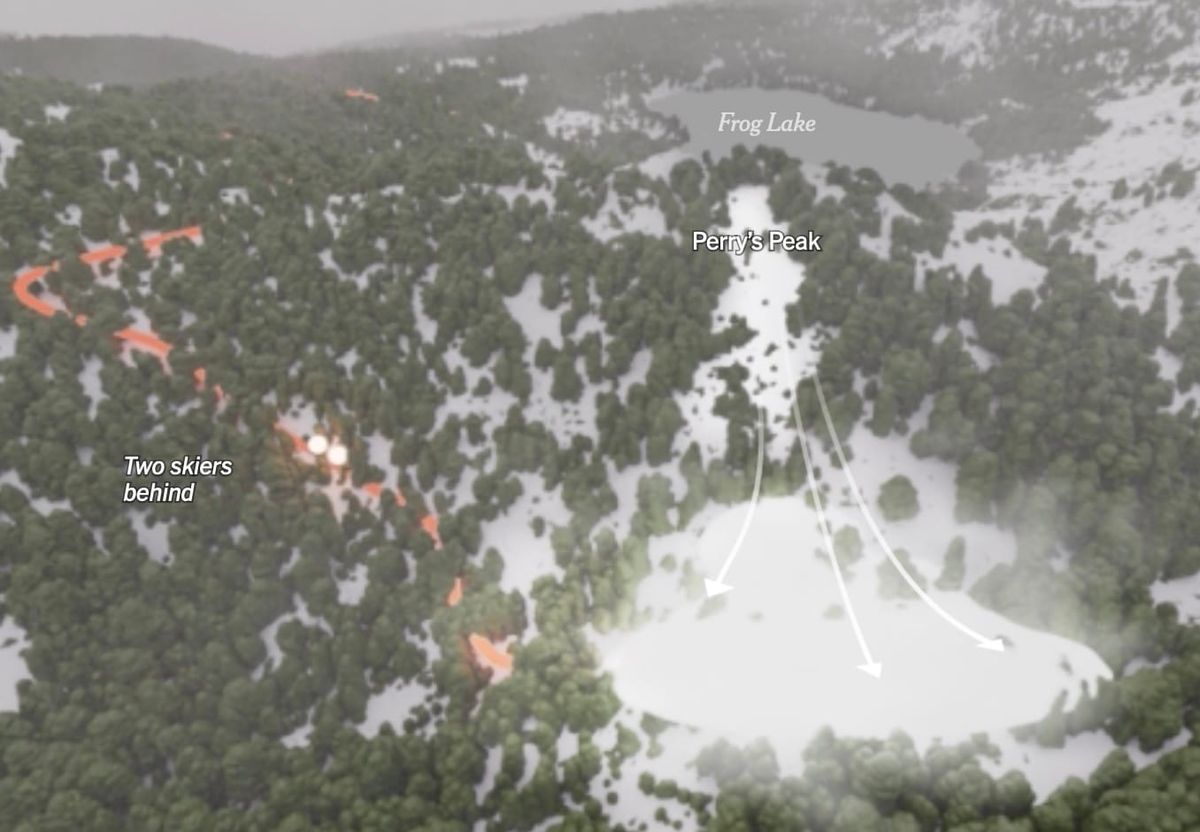
Last month, nine backcountry skiers died in an avalanche in the mountains near Lake Tahoe. The victims included six moms in their 40s and 50s; they were part of a group of eight friends who regularly went on outdoor adventures together. The other three victims were professional guides—two leading the group of eight friends and one leading a separate, smaller group.
When news of the deaths first broke, it pulled my focus for an obvious reason: I, too, am a middle-aged mom who loves escaping into the wilderness with friends. If not for the eye-watering price tag, this was exactly the kind of guided trip I might have considered.
And it wasn’t just a tragedy. It was a mystery. Why—when forecasters had set the chance of natural avalanches to “likely” and the chance of human-caused avalanches to “very likely”—would this group of 15 (four guides and 11 clients) not have stayed safe in their alpine huts? Also, if they were determined to head home that day, why hadn’t they opted for a less risky route? And why, oh why, had so many skiers—with seasoned professionals in their midst—proceeded in such a tight formation?
Eleven days after the avalanche, The New York Times published an account based on interviews with two of the survivors. But official investigations are still under way, and three of the survivors (including the only surviving guide) have not yet spoken publicly. As a result, much remains to be learned about this particular incident. Embedded in that account, however, was a list of factors known to compromise backcountry decision making more generally. As I pondered these points, I couldn’t help but notice: these are also the things that compromise all decision making.
- “People skiing familiar terrain—such as experienced guides on home turf—are more likely to assume a familiar route is safe.” This made me think again of Jeremy Siegel and other high-profile economists, who continue to believe that emerging technologies will create more jobs than they eliminate—because that’s what’s always happened in the past. I’d love to believe that, but I don’t. I think that agentic AI, iterating through recursive self-improvement (RSI), will—sooner rather than later—change the employment landscape in ways we’ve never before seen. We can’t put the toothpaste back in the tube, but also we shouldn’t calm down; instead, we should all start listening to Gina Raimondo*.
- “Skiers who see an opportunity as scarce or fleeting—such as a long-awaited trip or fresh powder—are more likely to downplay the danger.” This made me think of Iran. Would we have gone to war two Saturdays ago if Iran’s senior leadership hadn’t chosen to gather for a large in-person meeting? If the chance to notch what Trump perceived as a quick win hadn’t been dangled as a ‘now or never’?
- “Individuals wanting to fit in with the group may be reluctant to speak out.” This made me think (again) of Congress, which has ceded so much of its power to the executive branch, and big business, which—with only a few exceptions—has failed repeatedly to use its enormous influence for good.
- “Novices are prone to defer to someone they see as an expert, and not question their decisions.” This made me think of myself. In normal times, when I felt the country was run by public servants (Democratic or Republican) supported by staffers with deep domain expertise, I kept my head out of politics. I voted, of course, but beyond that, I stuck to what I knew. Now that the country is so obviously being run by self-dealers—and expertise has been replaced with loyalty—I’m less and less inclined to defer to anyone. I’m chockfull of questions.
In the coming months and years, let’s hope we can make our way down the proverbial mountain as safely as possible. One thing’s for sure, though: we’re short on guides we can follow blindly. We’re all going to have to think for ourselves.
Thanks for reading,
Kate
*“America Cannot Withstand the Economic Shock That Is Coming,” by Gina Raimondo, The New York Times, March 6, 2026.