Power Struggles Are Uncomfortable—and Necessary

First a short story on the subject of power:
My daughter Anna never liked sleep. From the moment she arrived, she resisted it with all her might. We spent Year One walking up and down the streets of Hong Kong, where she was born, and we spent her toddler years locked in battle: Chris and I putting her to bed, Anna crawling out of bed and popping up in our room, one inch from my eyelid, just moments after I had drifted off.
By the time she was four, we were so tired, and the house was so fully baby-proofed that we took a new, harder line: we locked our door and resolved to just let her roam. It sounds harsh, I know, but we were desperate. Think of it as the X Games version of “Cry It Out.”
That at least was the plan—our plan. Anna had a different plan. First, she tried the locked door. Then we heard her pad quietly away. Briefly, we felt triumphant. But soon she returned, and this time she said: “I’ve got Peter.”
Yes, dear reader, our daughter had TAKEN A HOSTAGE. Her baby brother, the soundest of sleepers, had been ripped from his bed, put in a half nelson, and dragged down the hall. (Side note: he seemed a little confused but was characteristically fine with whatever was happening.)
This brings me to data centers. A Princeton professor, Arvind Narayanan*, made waves last week with a post arguing that opposition to data centers does essentially nothing to hold back the AI industry. According to his calculations, “if a typical U.S. state enacts a 1-year moratorium, it slows AI efficiency progress by… 5-10 hours.” (The ellipses are mine, to create the mic drop I think he was going for.)
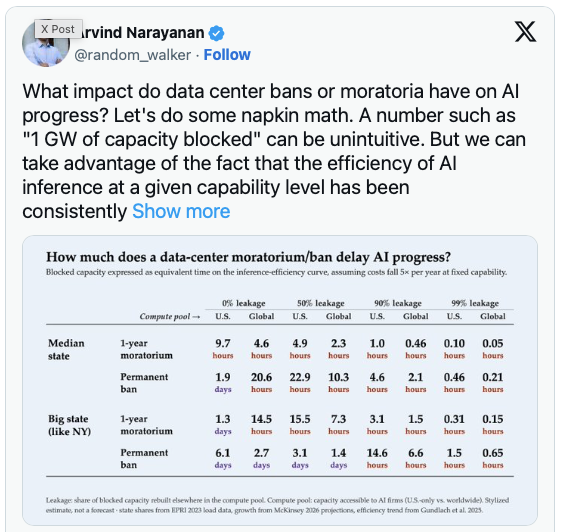
I like a color-coded table, and I appreciate the implied precision of two decimal places in the final columns, but whew: this seems like some serious AI fatalism. As someone who is not ready to let roughly six people with luxury bunkers determine our collective fate, I offer this counterpoint: what’s valuable about data center protests is not what they’re doing to the AI industry but what they’re doing for hundreds of communities across the country:
1. Data center opposition is not NOT working. Data center protests might look like old-fashioned NIMBY-ism, but they are arguably functioning more like labor unions—providing people who might otherwise have little leverage considerably more bargaining power. In the headlines, data center opposition appears to revolve around specific community concerns—energy, water, and land use on the one hand, tax revenue and job opportunities on the other. But zoom out and what I see is something way more profound: the return of real political power to people who have felt it slip steadily away over the last 40 or 50 years—due to globalization, automation, and the creeping capture of government by the extremely wealthy.
2. Communities that organize aren’t just extracting more from the AI industry in the short term; they’re also building strength for the political fights that lie ahead.
Even if data center protests fail to slow the AI industry by one nanosecond, they sure have served—across party lines—to wake We the People right up. As the implications of an AI economy continue to come into focus, the primaries that are taking place right now, the upcoming midterms, and the 2028 presidential election will be shaped in large part by one question wearing various costumes: “Hey Candidate Who Wants My Vote: are you on Team Oligarch or are you on Team Greater Good?”
3. These local debates are educating people like nothing else can—and my-oh-my do we need that. Ever since OpenAI released ChatGPT on November 30, 2022, we’ve mostly been embroiled in a stunted conversation: Is AI good or bad? Are you an optimist or a pessimist? Should we turn back time, and if so where is the dropdown for that??? As is so often the case, we need to scrap both the binary thinking and the magical thinking. Instead, we need to dig in: Good for who? Bad for what? Where there are gains to be had, what’s the best way to distribute them? What are all the possible risks? Can they be offset? And how will we—everyone who would be affected—decide which risks we’re prepared to take? In communities across the country, these conversations are actually happening now—and that in itself is a very good thing.
Notes:
Professor Narayanan’s Substack is called AI As Normal Technology. :-) For new readers: I am a big fan of innovation in general and technology in particular. However, I do not think AI is just like all the other technologies that have come before—and I continue to think that we urgently need new answers to what are genuinely new questions. Bill Gates agrees.
To any actual children who are reading this: GO. TO. BED. Even Anna admits she was wrong about the sleep thing.