I Thought A Lot About Encyclicals This Week
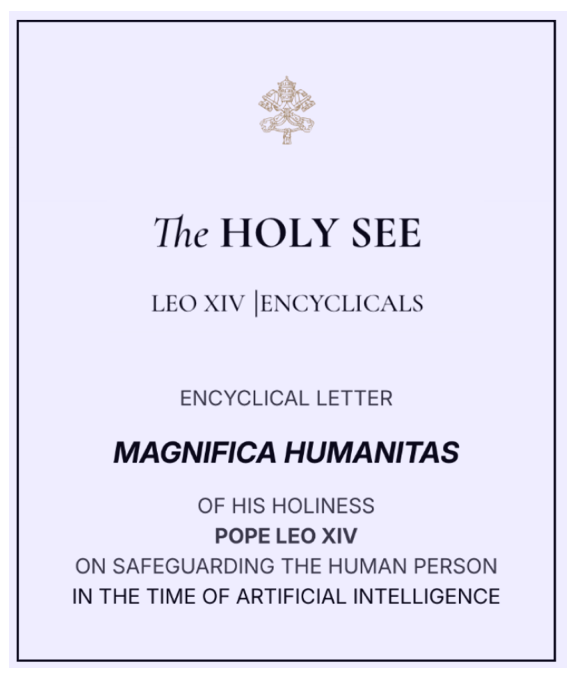
I think responding to the fastest-moving technology of all time with a 42,300-word treatise titled in Latin is objectively funny. So I decided to do some research on Pope Leo XIV’s AI encyclical.
1. Did Pope Leo actually write it?
It sounds like the idea for an encyclical does typically start with the Pope himself, but trusted advisors often serve as ghostwriters. Some sources also say that in this case, the Pope may have had some help from AI. If so—and the Vatican has neither confirmed nor denied this—I’m torn:
- On the one hand, I think anyone expounding on AI should have deep experience using it. Also, producing a book-length paper in 10 months—synthesizing information from scientists, engineers, political leaders, public officials, teachers, and parents around the world—is no small task. Bring on the protein shakes. Bring on all the tools.
- On the other hand, heavy AI use—if confirmed—would complicate one of the encyclical’s core messages about not devaluing human labor. Should we just not devalue it in our minds? Or should we not devalue it by paying for it, even when it is more expensive and slower? If the latter, how exactly does that work in market economies? At the grocery store, are we morally obligated to check out with human clerks or can we choose to buy from a machine? I sweat these questions, both as a citizen and a business owner. I’m not Catholic, but I’ll take guidance from anyone thoughtful, and the more layoffs I see, the more anxious I’ve become to find the answer. For example, I now read 42,300-word encyclicals.
2. Was Pope Leo’s encyclical originally written in Latin?
No, most modern Popes use their first language (English in Leo XIV’s case) during the drafting process. Once finished, encyclicals are distributed in multiple languages and until now, the official edition of any encyclical has always been entirely in Latin. But—something that has gone largely unnoticed this time around—there is no Latin edition of this latest encyclical. One way to view this: Pope Leo has not exactly turned to short-form video, but he does seem keen to move with the times.
From a practical standpoint, this makes sense, but because this also feels like the last nail in Latin’s coffin, I want to tell you briefly about one of my favorite teachers, Mr. Bober who taught Latin at the Seven Hills School in Cincinnati, Ohio. A Jesuit as I recall, Mr. Bober went every year to a conference where people spoke Latin all weekend. In his class, we had a quiz every single day, and if you did not bring a red ballpoint pen to grade your own paper, you got an automatic zero. Would a blue ballpoint do? No. What about a red felt tip? No. “I don’t think you’re going to be speaking Latin in the future,” he’d say. “I do think that one day you will go to an airport, and you will need to have your passport. You’re not going to be able to say, ‘I have this thing that is kind of like a passport.’ So, bring a red ballpoint pen every day—and don’t ever say that learning Latin was a waste of time. Got it?”
I did get it. Mr. Bober delighted in speaking a dead language, but he was also wise in a way that transcended time and place. He’s a big part of why I—something of a secular humanist—am nevertheless willing to turn to all sorts of faith leaders for wisdom.
3. This past Monday, Pope Leo broke with tradition again: instead of delegating the task to cardinals, he personally presented the AI encyclical. Furthermore, he did so alongside the co-founder of a company, Anthropic’s Christopher Olah. Is there any universe in which this was not the PR coup of the century for Anthropic?
No. No, there is not. Olah’s presence at the presentation was explained by the Vatican (according to the AP) as “part of its decade-long effort to engage Silicon Valley in dialogue over the human cost of AI.”
Fair—no mediator is ever going to come out against dialogue. But inviting just one company to such an important event was, with all due respect, a terrible mistake. I try to write these posts in a little bit of a vacuum (these days, critical thinking seems to require some level of withdrawal), so I’m not sure if “Pope-washing” is already a term that’s trending—but it should be: Anthropic already had a reputation for being more safety-oriented than other AI companies, and Olah’s high-profile appearance with the Pope only reinforced this.
The reality though is that there’s nothing actually safer about Anthropic: they, like all companies doing frontier work, are still operating in a world wholly free of AI regulation and largely ill prepared for the disruptions (good and bad) that are coming our way. Dario Amodei, Anthropic’s CEO, does seem like a particularly thoughtful leader. But he’s still just one person, and we, the 99.99%, are still exposed—as the encyclical itself says—to the aims and whims of a tiny handful of billionaires. That is an enormous, unacceptable risk.
I actually like the fact that industry was represented at the presentation. That feels pragmatic to me in a way that makes this encyclical more relevant—to Catholics and non-Catholics alike. But instead of singling out Anthropic, I wish Pope Leo had invited all the major players. And I wish he had publicly asked them—in a way that would be hard to dislodge from even their late-night brains—to please side at every turn with “Magnificent Humanity”
The difficult work of planning our collective future would still remain, but such a moment might have served as a meaningful re-set.